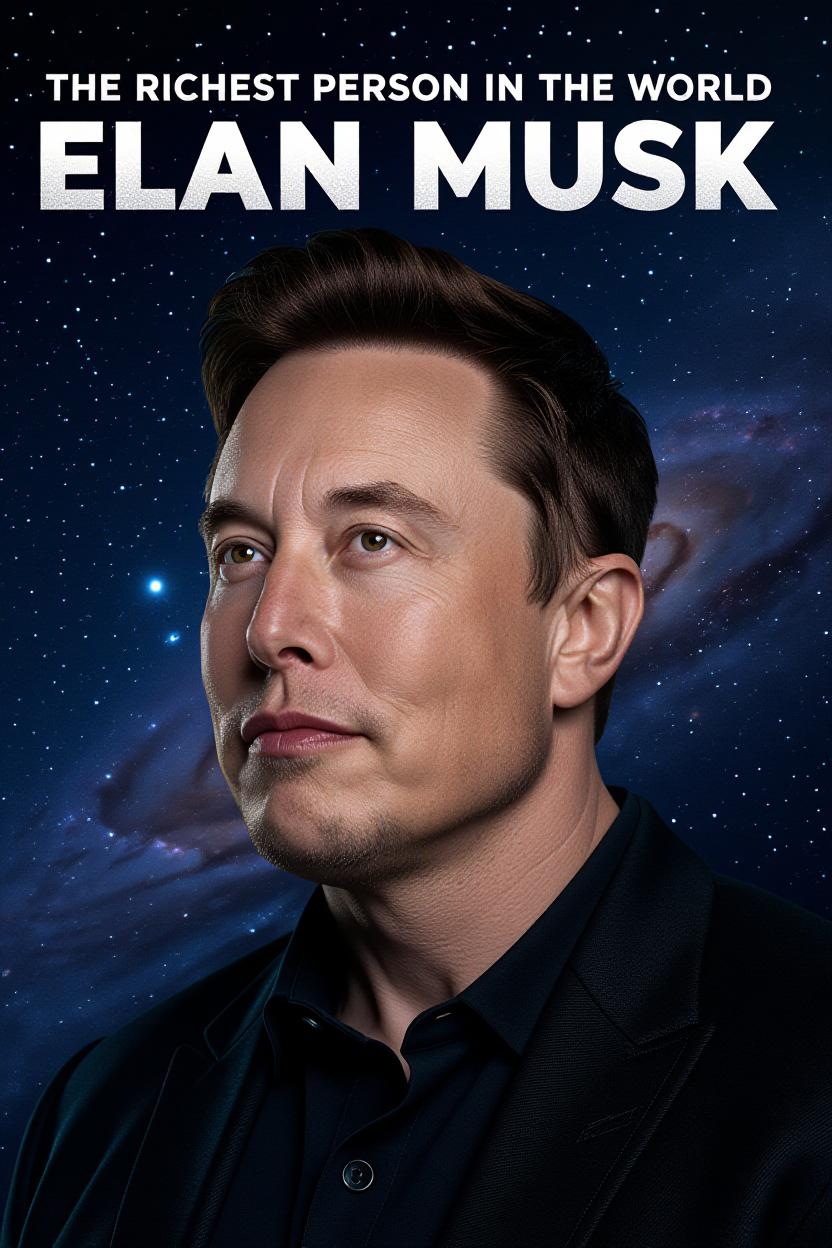
Elon Musk, the South African-born innovator whose audacious bets have reshaped industries from electric vehicles to space travel, stands as a colossus in the modern economy. As of October 2, 2025, Musk has etched his name into history as the first person to surpass a $500 billion net worth, cementing his position as the world’s richest individual—$150 billion ahead of second-place Larry Ellison. This milestone, driven by surging valuations in his core companies, underscores a trajectory that could make him the first trillionaire by 2033. Below is a comprehensive, multi-dimensional analysis drawing from his biography, business empire, innovative prowess, societal impact, and forward-looking ambitions. To deepen this exploration, I’ve spotlighted one standout article: Forbes’ “Elon Musk Just Became The First Person Ever Worth $500 Billion” (October 1, 2025), a timely breakdown of his wealth drivers and strategic maneuvers.
1. Biography: From Precocious Child to Global Disruptor
Elon Reeve Musk was born on June 28, 1971, in Pretoria, South Africa, to a family of contrasts: his mother, Maye Musk, a Canadian model and dietitian of British and Pennsylvania Dutch descent, embodied creativity and resilience; his father, Errol, a South African engineer and entrepreneur, was a domineering figure from whom Musk later became estranged following his parents’ 1979 divorce. Raised in the Anglican Church and baptized, Musk displayed early genius, teaching himself to code by age 10 and selling a video game, Blastar, at 12. Bullied at schools like Waterkloof House Preparatory and Pretoria Boys High, he sought escape through books on science fiction and physics.


To evade South Africa’s mandatory military service, Musk leveraged his mother’s Canadian roots, arriving in Canada in 1989. He toiled in odd jobs—shucking grain, cleaning boilers—before attending Queen’s University in Ontario. Transferring to the University of Pennsylvania in 1992, he earned dual bachelor’s degrees in physics and economics from the Wharton School in 1997. Admitted to Stanford’s materials science PhD program in 1995, Musk deferred after two days to chase the internet boom, co-founding Zip2 in 1995 (sold for $307 million in 1999) and X.com (evolving into PayPal, sold to eBay for $1.5 billion in 2002, netting him $176 million).
Musk’s personal life mirrors his intensity: three marriages (twice to Talulah Riley), 12 children (including a transgender daughter who estranged from him), and a self-described Asperger’s diagnosis. His drive stems from a “demon mode” work ethic—100+ hour weeks—and a fear of humanity’s extinction, fueling his multi-planetary vision. By 2025, at 54, Musk blends showmanship (e.g., Nazi salute controversy at Trump’s inauguration) with philanthropy via the Musk Foundation, though criticized for modest charitable payouts relative to his wealth.
2. Companies, Products, and Projects: A Portfolio of Moonshots
Musk’s empire spans six primary ventures, each tackling existential challenges like sustainable energy, space colonization, and human-AI symbiosis. Here’s a breakdown:
| Company | Founded | Key Products/Projects | Core Focus |
|---|---|---|---|
| SpaceX | 2002 | Falcon 9/Heavy rockets, Starship, Dragon capsule, Starlink (7,600+ satellites by May 2025) | Reusable rocketry, commercial spaceflight, global internet via satellites (e.g., aiding Ukraine in 2022). |
| Tesla | 2003 (joined 2004) | Model S/X/3/Y/Cybertruck, Roadster 2.0, Optimus humanoid robot, Full Self-Driving (FSD) software, Gigafactories | Electric vehicles (EVs), autonomous driving, energy storage (Powerwall), robotics. World’s top-selling vehicle: Model Y (2023). |
| X (formerly Twitter) | Acquired 2022 | Premium subscriptions, Grok AI chatbot, algorithm tweaks for “free speech” | Social media platform reimagined as “everything app” for payments, video, and AI integration. |
| xAI | 2023 (merged with X in March 2025 as xAI Holdings) | Grok AI models, “Project Colossus” (200,000 Nvidia H100 chips supercomputer) | Generative AI to “understand the universe,” competing with OpenAI. |
| Neuralink | 2016 | Brain-machine interfaces (e.g., N1 implant for paralysis patients; first human trial 2024) | Merging human cognition with AI; FDA-approved trials for restoring mobility. |
| The Boring Company | 2016 | Vegas Loop tunnels, Prufrock boring machines | Urban tunneling to alleviate traffic; expanded to hyperloop-inspired transit. |
These entities employ over 140,000 people and have disrupted automotive ($1T+ EV market shift), aerospace (NASA contracts worth billions), and tech (AI race).
3. Company-Wise Net Worth and Valuations (as of October 2025)
Musk’s fortune is tied to equity stakes, not liquid assets—primarily Tesla (public) and private firms like SpaceX. Total: $500 billion (peaked at $500.1B on October 1, settling at $499.1B). Breakdown:
| Company | Valuation | Musk’s Stake | Contribution to Net Worth | Notes |
|---|---|---|---|---|
| Tesla | $1.1T market cap | 12-13% (~$143-191B) | $191B | Stock up 4% on October 1 added $9.3B; includes options worth $133B (50% discounted, pending appeal). |
| SpaceX | $400B | 42% | $168B | Up from $350B (Dec 2024); private tender August 2025. |
| xAI Holdings (incl. X) | $113B (incl. debt) | 53% | $60B | Merger March 2025; xAI alone valued at $75B (July 2025), eyeing $200B. |
| Neuralink | ~$2B | ~50% (est.) | ~$1B | Last round 2021; human trials boosting interest, but no 2025 valuation update. |
| The Boring Company | ~$5.7B (2022 est.; no 2025 data) | Majority | <$1B | Minor contributor; Vegas projects ongoing. |
| Other (SolarCity/Tesla Energy, etc.) | Integrated into Tesla | N/A | Negligible standalone | Folded into Tesla post-2016 acquisition. |
These stakes propelled Musk from $24.6B (March 2020) to $500B, fueled by Tesla’s rebound and SpaceX’s NASA dominance.
4. Innovation, Execution, and Impact: The Musk Method
Innovation: Musk excels at “first principles” thinking—deconstructing problems to fundamentals. SpaceX pioneered reusable rockets (Falcon 9 landings slashed costs 90%), Tesla accelerated EV adoption (global sales up 35% YoY by 2025), and Neuralink/xAI push brain-AI fusion and ethical AI (Grok as “truth-seeking” alternative to ChatGPT). His Hyperloop (2013) inspired pod transit prototypes.
Execution: Relentless—firing 80% of Twitter staff post-acquisition, scaling Tesla Gigafactories to 5M+ vehicles/year. Challenges include delays (Starship explosions as “rapid unscheduled disassemblies”) and controversies (e.g., X’s hate speech surge post-2022). Yet, execution yields results: Starlink connects 3M+ users; Optimus robots target $20K-30K units in 2025.
Impact: Transformative yet polarizing. Tesla decarbonized transport (emissions cut equivalent to 10M cars off roads); SpaceX democratized space (crewed ISS flights since 2020). Societally, Musk amplifies disinformation (1.2B views on misleading election claims, 2025) and influences policy via DOGE (Department of Government Efficiency, co-led with Vivek Ramaswamy under Trump, targeting agency cuts). Critics decry his rightward shift, transphobia accusations, and foundation’s $9.4B assets vs. $160M donations (2021). Positively, he’s boosted STEM interest and universal basic income discourse amid AI job displacement.
5. Upcoming Future Plans: Bets on Autonomy, AI, and the Stars
Musk’s 2025-2030 roadmap emphasizes scaling autonomy and multi-planetary life:
- Tesla: Robotaxi fleet launch (delayed to late 2025 in California; aims for millions by 2026, allowing owners to rent vehicles for passive income). Optimus robots: 5,000 units in 2025 (80% of future value), shifting from EVs to AI/robotics. New $1T pay package ties to “Mars-shot” milestones (e.g., 10x market cap growth by 2035).
- SpaceX: Starship Mars missions (uncrewed 2026, crewed 2028); Starlink expansion to 42,000 satellites for global coverage.
- xAI/Neuralink: “Project Colossus” supercomputer (August 2025) for AI training; Neuralink scaling implants to treat blindness/depression by 2027.
- Broader: DOGE reforms (e.g., abolishing CFPB); potential Tesla Phone (rumored 2025); Hyperloop commercialization via Boring Co.
These align with Musk’s “humanity as multi-planetary species” ethos, with AI safety as a red line.
Spotlight: Exploring the Best Article – Forbes’ $500B Milestone Deep Dive
For a singular, incisive lens on Musk’s ascent, the Forbes piece by Matt Durot (October 1, 2025) stands out as the premier 2025 analysis—timely, data-rich, and forward-gazing. It chronicles his wealth arc (from $100B in 2020 to $500B), attributing 75% to Tesla/SpaceX surges amid EV/AI booms. Key insights: Musk’s “demon mode” execution turned Tesla’s near-bankruptcy (2008) into a $1.1T behemoth; the xAI-X merger (March 2025) values his AI bet at $60B, hedging OpenAI regrets. Impact-wise, it hails his industry pivots (e.g., robots over cars) but flags risks like regulatory hurdles for robotaxis. Future: A $1T Tesla package vests in 2033 if milestones hit, positioning Musk as “safety guardian” for AI/humanoid fleets. This article’s blend of financial forensics and narrative flair makes it essential reading, revealing how Musk’s 12% Tesla stake alone rivals entire fortunes.
In sum, Musk’s $500B empire isn’t mere wealth—it’s a high-stakes gambit on humanity’s future, blending brilliance with controversy. As the #1 richest, his shadow looms large over tech, policy, and exploration.