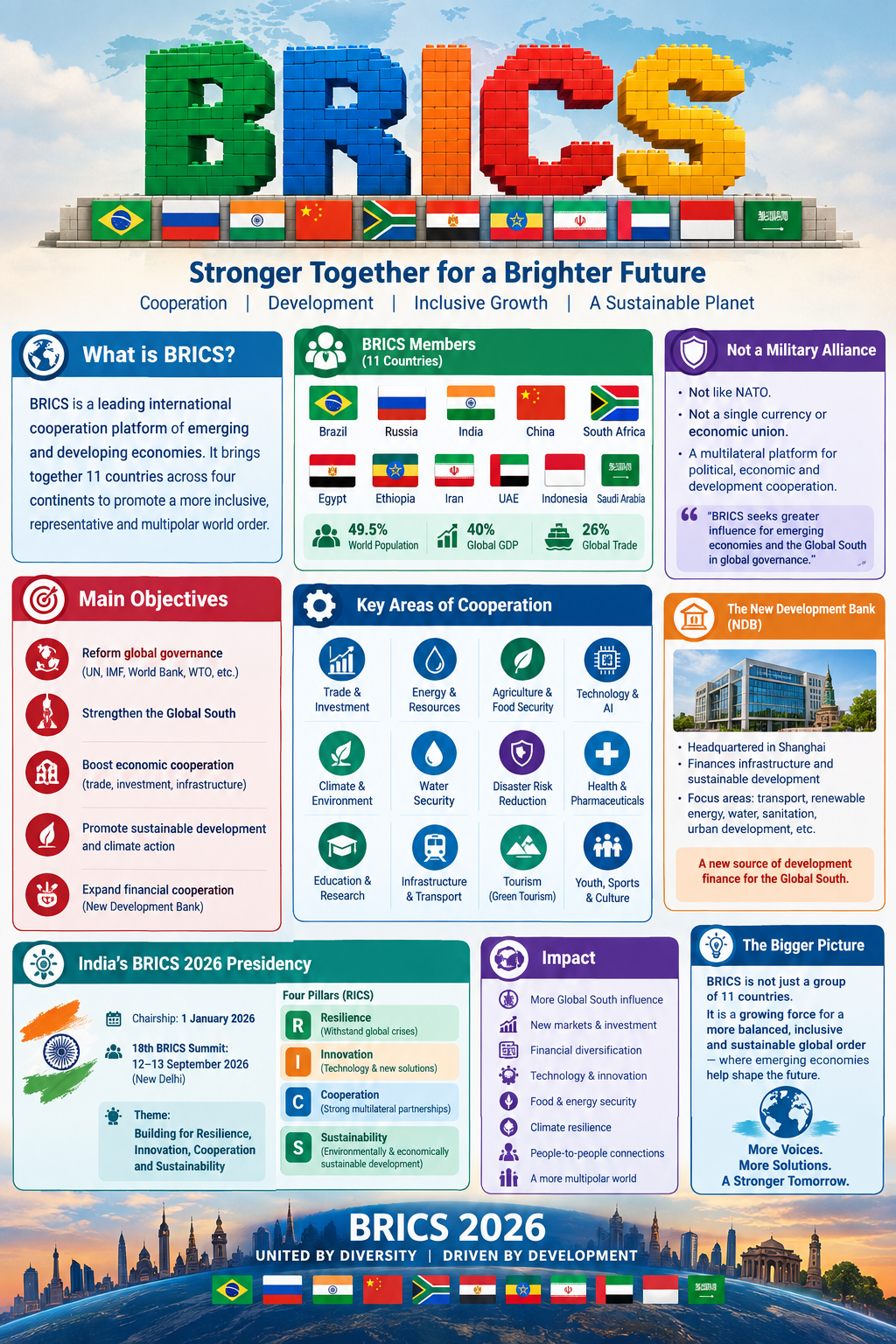
I examined the official BRICS 2026 India material available through the government sources and cross-checked it with India’s Ministry of External Affairs and Press Information Bureau. The BRICS 2026 official website itself is currently not returning its page content to the web crawler, so I cannot honestly claim that I scanned every hidden page of that site. I have therefore combined the official BRICS 2026 information with the Indian government’s official BRICS documents and the latest 2026 reporting. (Press Information Bureau)
1. What is BRICS?
BRICS is a major international cooperation grouping of emerging and developing economies. The name originally came from:


- B — Brazil
- R — Russia
- I — India
- C — China
- S — South Africa
The term BRIC was originally coined by Goldman Sachs economist Jim O’Neill in 2001 to describe Brazil, Russia, India and China as rapidly rising economies. South Africa joined in 2010, creating BRICS. (Press Information Bureau)
But BRICS has now moved far beyond its original four-country economic concept.
Current BRICS members
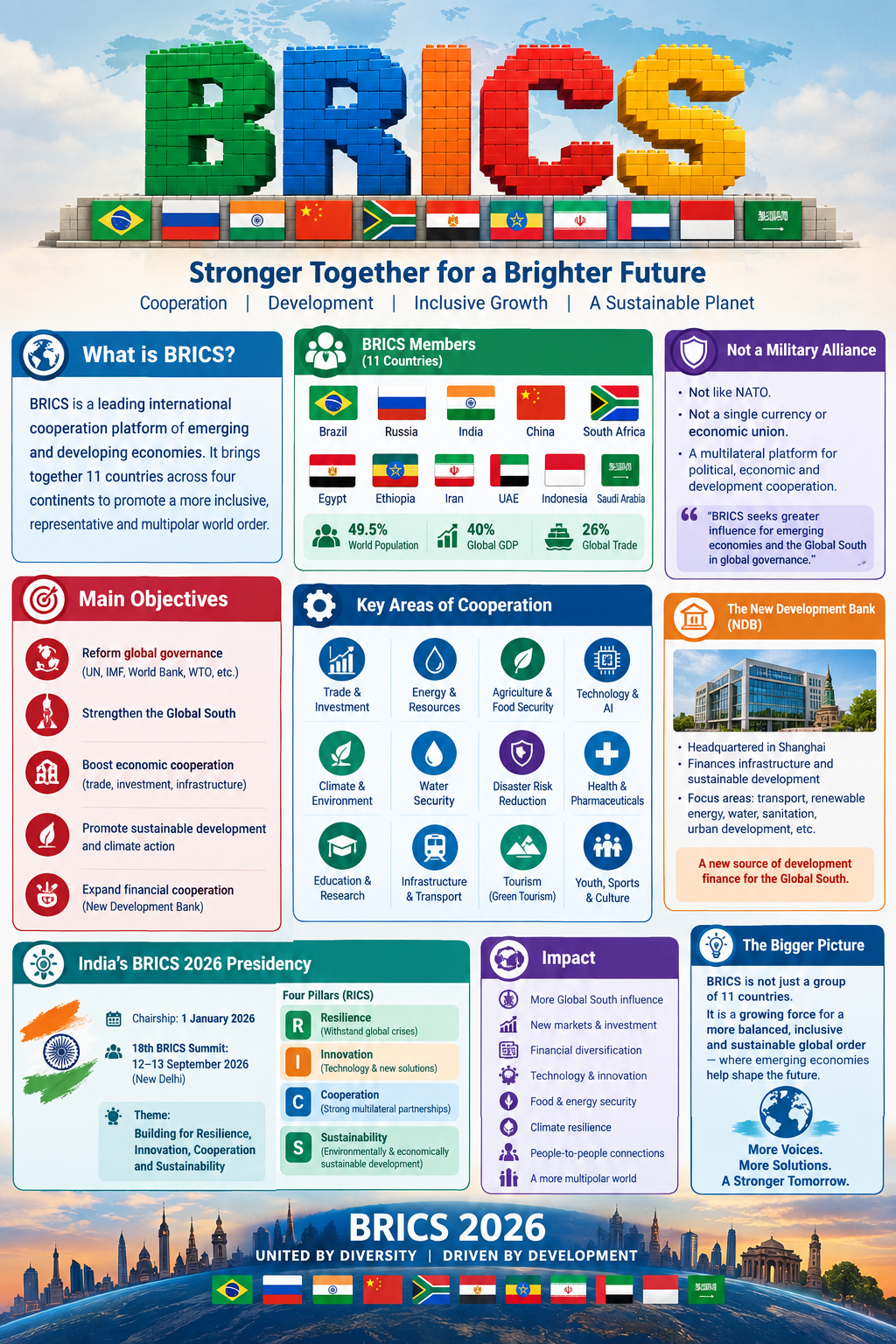
As of India’s 2026 chairship, BRICS comprises 11 countries:
- Brazil
- Russia
- India
- China
- South Africa
- Egypt
- Ethiopia
- Iran
- United Arab Emirates
- Indonesia
- Saudi Arabia
- Bricks
According to India’s Press Information Bureau, these countries together represent approximately:
49.5% of the world’s population
40% of global GDP
26% of global trade
That gives BRICS enormous demographic and economic weight. (Press Information Bureau)


2. Is BRICS an alliance like NATO?
No.
This is one of the most important things to understand.
BRICS is not a military alliance and does not operate like NATO.
It is better understood as a multilateral political, economic and development cooperation platform.
Its members have very different:
- political systems
- economic structures
- foreign-policy interests
- strategic relationships
- security priorities
Nevertheless, they cooperate where their interests overlap.
A useful way to understand BRICS is:
BRICS attempts to give emerging economies greater collective influence in shaping the international system.
It seeks greater representation for developing countries in institutions such as the UN, IMF, World Bank and other global governance mechanisms.
3. Why was BRICS created?
The fundamental question behind BRICS is:
Who gets to make the rules of the global economy?
The international financial and political architecture created after World War II has traditionally been heavily influenced by the United States and Europe.
BRICS countries argue that today’s economic and demographic realities are different.
Large emerging economies now represent enormous portions of:
- world population
- production
- trade
- energy
- food production
- natural resources
- technology
- investment
Therefore, BRICS seeks a more representative and multipolar international system.
India’s official description says BRICS has become an important platform for coordinating economic policy among major emerging economies and for advancing Global South interests in multilateral institutions. (Press Information Bureau)
4. The major objectives of BRICS
BRICS has several interconnected objectives.
4.1 Reform global governance
One of the biggest objectives is to make international institutions more representative.
BRICS advocates reforms involving institutions such as:
- United Nations
- UN Security Council
- IMF
- World Bank
- WTO
- international financial institutions
The basic argument is:
Global institutions should reflect the economic and demographic reality of the 21st century.
5. Strengthening the Global South
BRICS has increasingly positioned itself as an important platform for the Global South.
The Global South broadly includes developing and emerging countries across:
- Asia
- Africa
- Latin America
- Middle East
- parts of the Caribbean and Pacific
BRICS provides these countries with an additional diplomatic and economic platform.
This is particularly important because BRICS now stretches across Latin America, Africa, Asia and the Middle East. (Press Information Bureau)
6. Economic cooperation
Economic cooperation is at the heart of BRICS.
Areas include:
Trade
Increasing trade among member countries.
Investment
Encouraging cross-border investment.
Infrastructure
Financing roads, energy, transportation and digital infrastructure.
Industry
Increasing industrial cooperation.
Agriculture
Sharing agricultural technology and research.
Energy
Cooperation in oil, gas, renewable energy and energy security.
Finance
Developing alternative mechanisms for financial cooperation.
7. The New Development Bank — perhaps BRICS’ most important institution
One of BRICS’ most concrete achievements is the New Development Bank (NDB).
It was established to finance infrastructure and sustainable-development projects.
The bank is headquartered in Shanghai.
Its purpose is broadly to provide financing for projects involving:
- transport
- renewable energy
- water
- sanitation
- urban development
- infrastructure
- environmental sustainability
The NDB is particularly significant because it gives developing countries another source of development finance.
India’s government identifies the operationalisation of the NDB and its early financing of renewable-energy projects as a major BRICS institutional achievement. (Press Information Bureau)
8. BRICS and de-dollarisation
This is probably the most internationally discussed BRICS issue.
There is significant discussion about reducing excessive dependence on the US dollar in international transactions.
But there is an important distinction:
BRICS is not currently a single alternative currency system.
Rather, BRICS discussions have included:
- increasing use of national currencies
- improving cross-border payment systems
- reducing transaction costs
- strengthening financial cooperation
- exploring alternatives to dependence on a single currency
The idea is essentially:
More choices in international finance rather than necessarily immediately replacing the dollar.
This is strategically important because many BRICS economies are major commodity producers and traders.
However, replacing the dollar globally would be extremely difficult because of the dollar’s enormous financial infrastructure and international liquidity. Independent analysis also cautions against interpreting BRICS simply as an anti-dollar alliance. (Quincy Institute)
9. BRICS and technology
Technology is becoming increasingly important.
BRICS cooperation increasingly covers:
- artificial intelligence
- digital economy
- cybersecurity
- digital public infrastructure
- emerging technologies
- research
- innovation
- technology transfer
- startups
- digital connectivity
This is particularly relevant to India’s 2026 presidency.
India has placed innovation at the centre of its BRICS agenda.
10. BRICS and artificial intelligence
AI is becoming a major geopolitical issue.
The BRICS countries include major AI powers and large technology markets.
India’s 2026 agenda places innovation prominently within its four-part framework:
R — Resilience
I — Innovation
C — Cooperation
S — Sustainability
The official theme of India’s 2026 BRICS presidency is:
“Building for Resilience, Innovation, Cooperation and Sustainability.”
India has explicitly linked these priorities to development, sustainability, innovation and the interests of the Global South. (Press Information Bureau)
11. BRICS and climate change
Climate and sustainability are increasingly important BRICS areas.
Cooperation can involve:
- renewable energy
- climate finance
- sustainable agriculture
- green technology
- water management
- climate-resilient infrastructure
- environmental protection
- disaster resilience
This is especially important because several BRICS members are highly vulnerable to:
- floods
- droughts
- heat waves
- cyclones
- water shortages
- climate-related agricultural disruption.
12. BRICS and disaster risk reduction
This is an especially interesting development in 2026.
Under India’s chairship, BRICS has expanded cooperation on disaster risk reduction.
The countries have discussed:
- early-warning systems
- climate-resilient infrastructure
- disaster financing
- technology
- knowledge exchange
- international cooperation
A 2026 BRICS disaster-risk meeting resulted in a joint declaration emphasizing stronger early-warning systems and resilient critical infrastructure. (TV BRICS)
This creates a potentially important field for countries such as Nepal, which face earthquakes, floods, landslides, glacial hazards and climate-related disasters.
13. BRICS and agriculture
Agriculture is another major area.
BRICS countries collectively represent enormous agricultural:
- production
- consumer markets
- land resources
- water resources
- food systems
India has contributed to the development of a BRICS Agriculture Research Platform.
Potential cooperation includes:
- agricultural research
- food security
- climate-smart agriculture
- technology
- irrigation
- agricultural productivity
- farmer innovation.
14. BRICS and railways
Another interesting initiative is the BRICS Railway Research Network.
The objective is to facilitate cooperation and knowledge sharing concerning railway technology and transportation.
This could involve:
- railway technology
- infrastructure
- logistics
- high-speed rail
- safety
- research
- transportation efficiency.
15. BRICS and water
India has also introduced a BRICS Water Ministers Meeting.
Water is becoming one of the most important strategic resources of the 21st century.
Potential cooperation involves:
- water security
- river systems
- groundwater
- irrigation
- water conservation
- wastewater treatment
- climate adaptation
- sustainable water management.
16. BRICS and tourism
India has introduced a BRICS Alliance for Green Tourism.
This links tourism with:
- sustainability
- environmental protection
- local economies
- responsible tourism
- cultural exchange.
For countries such as Nepal, this could be strategically valuable because tourism is a major economic sector.
17. BRICS and youth
BRICS is not limited to presidents and ministers.
There are also mechanisms involving:
- youth
- students
- entrepreneurs
- researchers
- academics
- think tanks
- civil society
- business communities
- cultural organisations.
India’s previous BRICS initiatives have included youth summits, BRICS Games and think-tank cooperation. (Ministry of External Affairs)
18. BRICS and sports
The grouping has also developed a BRICS Sports Council.
Sports diplomacy can contribute to:
- youth interaction
- cultural exchange
- people-to-people relationships
- international understanding.
The establishment of a BRICS Sports Council has been identified among India’s institutional initiatives. (Press Information Bureau)
19. BRICS and education/research
Research cooperation is another major component.
BRICS countries cooperate through:
- universities
- research institutions
- think tanks
- academic exchanges
- innovation programmes
- scientific research.
This is strategically important because BRICS countries possess enormous scientific and technological capacity.
20. BRICS and health
Health cooperation includes areas such as:
- public health
- pandemic preparedness
- pharmaceutical cooperation
- medical research
- healthcare technology
- traditional medicine
- health-system strengthening.
The COVID-19 experience significantly increased the importance of this agenda.
21. BRICS and energy
Energy is particularly important because BRICS contains major:
Oil producers
Russia, Saudi Arabia, UAE, Iran
Major energy consumers
China, India
Emerging energy markets
Brazil, South Africa, Indonesia and others.
Therefore BRICS can potentially influence:
- energy security
- oil markets
- renewable energy
- energy investment
- energy technology
- transition to cleaner energy.
22. BRICS expansion
The transformation from BRIC to today’s larger BRICS is extremely significant.
Original concept
2001: BRIC concept
Institutional formation
2009: First BRIC summit
South Africa
2010: BRICS
Major expansion
2024: Egypt, Ethiopia, Iran and UAE joined
Indonesia
2025: Indonesia became a member.
This expansion dramatically changed BRICS’ geographic and geopolitical weight. (Press Information Bureau)
23. Why did countries want to join BRICS?
Countries have different motivations.
Some seek:
Economic opportunities
Others seek:
Investment
Others:
Political influence
Others:
Greater Global South representation
Others:
Alternative diplomatic partnerships
And some see BRICS as a way to reduce excessive dependence on Western-led institutions.
Therefore, it would be incorrect to say:
“All BRICS countries have one common foreign policy.”
They do not.
Their interests frequently conflict.
24. BRICS’ biggest strength
The biggest strength is scale.
Think about the combination:
Population + energy + natural resources + manufacturing + technology + agriculture + markets + finance.
Few international groupings combine all of these.
That gives BRICS considerable potential bargaining power.
25. BRICS’ biggest weakness
The biggest weakness is diversity of interests.
Consider:
China and India have strategic competition.
India and China have unresolved border issues.
Russia has a fundamentally different relationship with the West.
Saudi Arabia and Iran have competing regional interests.
Brazil has different geopolitical priorities from China.
Therefore, reaching consensus can be difficult.
BRICS is consequently more effective in areas of practical cooperation than in creating a unified foreign policy.
Independent analysis describes BRICS as a heterogeneous coalition whose influence is real but constrained by differences among members. (Quincy Institute)
26. India’s BRICS 2026 presidency
This is particularly important because India is chairing BRICS in 2026.
India assumed the chairship on:
1 January 2026
and will host the:
18th BRICS Summit
in New Delhi on:
12–13 September 2026
India’s 2026 theme is:
Building for Resilience, Innovation, Cooperation and Sustainability
India identifies four central pillars:
| Pillar | Meaning |
|---|---|
| Resilience | Ability to withstand global crises |
| Innovation | Technology, science and new solutions |
| Cooperation | Stronger multilateral partnerships |
| Sustainability | Environmentally and economically sustainable development |
27. What does India’s BRICS 2026 agenda mean?
India is attempting to shift BRICS toward a more practical and solutions-oriented organisation.
Rather than simply making political declarations, the focus is increasingly on:
Problem → Research → Innovation → Cooperation → Implementation → Impact
This is an important evolution.
India’s government describes its objective as strengthening existing BRICS achievements and improving institutional effectiveness while putting development, sustainability and innovation at the centre. (Press Information Bureau)
28. BRICS 2026 activities
The BRICS calendar is much larger than the leaders’ summit.
There are activities involving:
Government
- leaders’ summit
- foreign ministers
- finance ministers
- trade ministers
- agriculture ministers
- health ministers
- environment ministers
- water ministers
- disaster-risk officials
Knowledge
- think tanks
- universities
- researchers
- policy dialogues
- research networks
Business
- business forums
- investment discussions
- trade
- entrepreneurship
- industrial cooperation
Society
- youth
- sports
- culture
- media
- civil society
- people-to-people exchanges.
India’s first BRICS Sherpa meeting in February 2026 formally presented the four priorities for the presidency and began coordinating the year’s agenda. (Ministry of External Affairs)
29. BRICS’ impact on the global power structure
This is where BRICS becomes geopolitically important.
The world is increasingly moving from a simple:
US/West-centred system
toward a more complicated:
multipolar system.
BRICS contributes to that transformation.
But it does not mean that the United States or Europe are disappearing from global politics.
Rather:
BRICS increases the number of centres of influence.
China, India, Russia, Brazil, Saudi Arabia, UAE and other members increasingly exercise independent strategic choices.
30. BRICS and the United States
BRICS is sometimes portrayed as:
“BRICS versus America.”
That is too simplistic.
There is competition, particularly over:
- global governance
- finance
- strategic influence
- technology
- trade
- international institutions.
But BRICS members also maintain substantial economic relationships with the US and Europe.
Therefore BRICS is better understood as strategic diversification rather than simply an anti-American organisation.
31. BRICS and China
China is arguably the most economically powerful BRICS member.
China brings:
- huge manufacturing capacity
- enormous trade
- infrastructure finance
- technology
- global supply chains
- major investment capability.
This makes China extremely influential inside BRICS.
However, India and other members also seek to prevent BRICS from becoming simply a China-led organisation.
32. BRICS and India
India occupies a unique position.
India has relationships with:
- United States
- Europe
- Russia
- Japan
- Middle East
- Africa
- Global South
Consequently, India can act as a bridge between different geopolitical blocs.
That makes India’s 2026 presidency particularly important.
India has explicitly stated that it wants BRICS to become more practical, balanced and responsive. (Ministry of External Affairs)
33. BRICS and Nepal
This is where the subject becomes particularly relevant for Nepal.
Nepal is not a BRICS member.
But Nepal can potentially benefit from BRICS cooperation indirectly and through engagement with individual BRICS countries.
Potential sectors include:
Infrastructure
China, India and other BRICS economies have enormous infrastructure capacity.
Tourism
Nepal could connect with the expanding BRICS tourism market.
Agriculture
BRICS agricultural research could offer technology and knowledge opportunities.
Disaster management
This may be especially important for Nepal.
AI and digital transformation
Nepal could learn from India’s digital public infrastructure and China’s technology ecosystem.
Renewable energy
Nepal’s hydropower potential creates opportunities for cooperation and investment.
Education
Universities and research institutions could develop BRICS-related academic partnerships.
Investment
Nepal could position itself as a bridge between India and China.
34. A particularly important opportunity for Nepal: disaster technology
Considering Nepal’s vulnerability to:
- earthquakes
- floods
- landslides
- glacial lake outburst floods
- extreme rainfall
- climate change
BRICS cooperation in early-warning systems, resilient infrastructure, AI, satellite technology and disaster-risk reduction could be highly relevant.
The 2026 BRICS disaster-risk agenda specifically emphasizes early-warning systems, resilient infrastructure, technology and financing. (TV BRICS)
This could become an area where Nepal seeks structured cooperation with India, China and other BRICS countries.
35. The deeper significance of BRICS
The real story of BRICS is not simply:
“A group of 11 countries.”
The deeper story is:
The redistribution of global economic and political power.
The 20th century was dominated by a relatively small number of industrial powers.
The 21st century is increasingly characterised by:
multiple centres of economic power.
BRICS represents one institutional expression of that transition.
36. BRICS’ measurable impact
BRICS has already produced tangible institutions and cooperation mechanisms.
Among the important outcomes are:
- New Development Bank
- financial cooperation
- expanded trade cooperation
- research networks
- agricultural cooperation
- railway research cooperation
- sports cooperation
- youth programmes
- disaster-risk cooperation
- water cooperation
- green tourism
- expanded Global South diplomatic coordination.
37. But expectations should be realistic
It would be wrong to describe BRICS as:
❌ a new NATO
❌ a military alliance
❌ a single economic union
❌ a single currency zone
❌ a unified anti-US bloc
❌ a replacement for the United Nations.
It is better described as:
A flexible multilateral platform through which major emerging economies coordinate economic, political, developmental and Global South interests.
38. The BRICS 2026 story in one sentence
If I were writing this as a major international news analysis, the central headline would be:
“BRICS 2026: India seeks to transform an expanding Global South coalition into a more practical engine of resilience, innovation, cooperation and sustainable development.”
India’s 2026 presidency comes at a particularly consequential moment because the organisation is simultaneously dealing with expansion, geopolitical tensions, global economic fragmentation, AI transformation, climate change, financial reform and the search for a more representative international order. (Press Information Bureau)
BRICS 2026 — the strategic picture
| Area | BRICS objective | Potential impact |
|---|---|---|
| Global governance | Reform institutions | More Global South influence |
| Trade | Increase intra-BRICS trade | New markets |
| Finance | NDB & financial cooperation | Alternative development finance |
| Currency | More local-currency transactions | Reduced transaction dependence |
| AI | Technology cooperation | Digital transformation |
| Agriculture | Research & food security | Greater resilience |
| Energy | Cooperation | Energy security |
| Climate | Sustainable development | Green transition |
| Water | Water cooperation | Resource security |
| Disaster | Early warning & resilience | Reduced disaster losses |
| Tourism | Green tourism | Sustainable travel |
| Youth | Exchanges | Human-capital development |
| Sports | BRICS Sports Council | People-to-people diplomacy |
| Research | Research networks | Innovation |
| Infrastructure | Development finance | Connectivity |
Bottom line
BRICS is becoming much more than the acronym created in 2001. It has evolved from an economic concept involving four emerging economies into a broad diplomatic and development platform spanning 11 major economies across four continents. In 2026, India’s presidency is attempting to push the organisation toward a practical agenda centred on resilience, innovation, cooperation and sustainability. (Press Information Bureau)
Its ultimate impact will depend on whether BRICS can move from declarations to implementation—especially in finance, technology, climate resilience, disaster management, trade, AI and sustainable development. Its greatest opportunity is its enormous collective scale; its greatest challenge is the very different interests of its members.
For Nepal, BRICS should therefore be viewed not merely as geopolitics, but as a potential platform for technology transfer, disaster resilience, hydropower, tourism, agriculture, AI, education, investment and Global South cooperation.