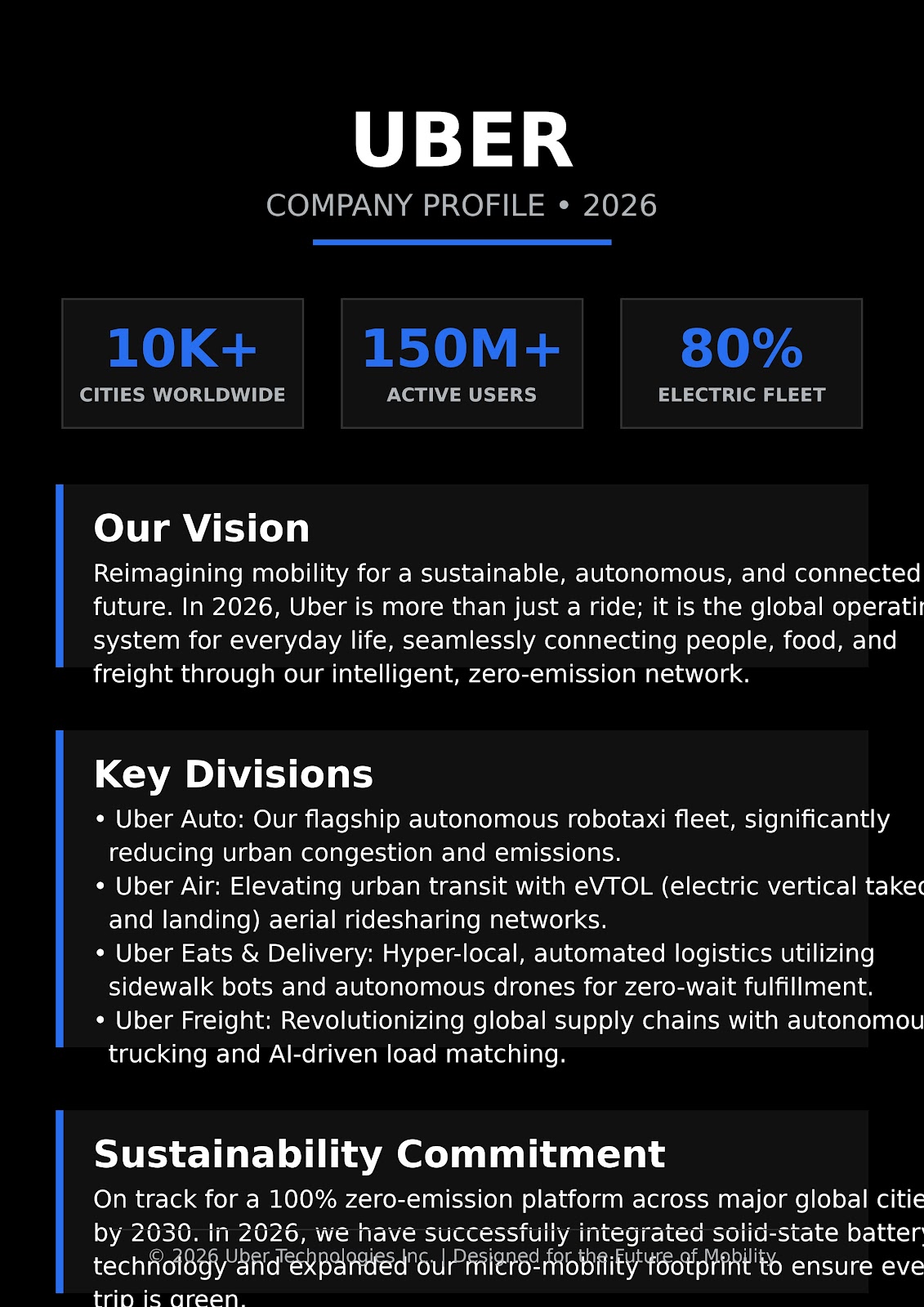
Uber Technologies, Inc. is a global mobility and technology company headquartered in San Francisco, California, USA. Uber operates one of the world’s largest digital transportation and delivery platforms, connecting riders, drivers, restaurants, couriers, and businesses through a single mobile application.
Basic Information
Item
Details
Company Name
Uber Technologies, Inc.
Founded
2009
Headquarters
San Francisco
Founders
Travis Kalanick and Garrett Camp
Current CEO
Dara Khosrowshahi
Countries Served
Approximately 70 countries
Cities Served
More than 10,500 cities
Employees
Approximately 34,000 employees (2025)
Monthly Active Users
Over 202 million
Drivers & Couriers
More than 10 million globally
Key Features of the Uber App
1. Ride-Hailing Services
UberX
Uber Comfort
Uber Black
Uber XL
Taxi Integration
Motorcycle Taxi (selected countries)
2. Food Delivery
Uber Eats
Restaurant ordering
Grocery delivery
Retail delivery
3. Business Services
Uber for Business
Corporate transportation
Employee mobility management
4. Freight & Logistics
Digital freight marketplace
Truck booking platform
5. Safety Features
Real-time GPS tracking
Emergency assistance button
Trip sharing
Driver verification
AI-based safety monitoring
6. Digital Payments
Credit/Debit Cards
Digital Wallets
Mobile Payments
Cash payments in selected countries
Unique & Innovative Modules
AI-Powered Demand Prediction
Uber uses machine learning and AI to:
Predict demand
Optimize routes
Reduce wait times
Dynamic pricing (Surge Pricing)
Multi-Service Super App
One app provides:
Transportation
Food delivery
Grocery delivery
Parcel delivery
Freight logistics
Autonomous Vehicle Integration
Uber is partnering with autonomous vehicle companies including:
Waymo
Nuro
Lucid Motors
The company aims to become a major platform for autonomous transportation.
Uber One Membership
Subscription model providing:
Discounted rides
Free delivery
Loyalty benefits
Priority services
Global Network
6
Global Reach
70+ countries
10,500+ cities
202+ million monthly users
40+ million trips and deliveries daily
72+ billion lifetime trips completed
Financial Performance (2025)
Metric
Value
Revenue
US$ 14.37 Billion
Gross Bookings
US$ 193.45 Billion
Adjusted EBITDA
US$ 2.49 Billion
Monthly Users
202 Million
Trips Completed
13.57 Billion
Net Worth / Market Value
Uber’s market capitalization fluctuates with the stock market. During 2025–2026 it has generally been valued well above US$150 billion, making it one of the world’s largest mobility technology companies.
Major Investors
Early investors included:
Benchmark Capital
Google Ventures
Goldman Sachs
SoftBank Group
Saudi Arabia Public Investment Fund
Toyota Motor Corporation
Total Investment Raised
Before becoming a public company, Uber raised approximately US$25 billion+ from venture capital and strategic investors, making it one of the largest venture-funded startups in history.
Founder & Leadership Team
Founders
Garrett Camp
Travis Kalanick
Executive Leadership
Dara Khosrowshahi (CEO)
Ronald Sugar
Senior leadership teams overseeing:
Mobility
Delivery
Finance
Technology
Global Operations
Uber Entry in Nepal
As of June 2026, Uber has not officially launched ride-hailing operations in Nepal. Nepal’s market is currently served by local and regional ride-sharing platforms such as:
Pathao
inDrive
Sajilo
Potential Opportunities for Uber in Nepal
Tourism transportation
Airport transfers
Food delivery
Electric vehicle ride-sharing
Corporate transportation
Intercity mobility services
If Uber enters Nepal, it would likely partner with local transportation operators and comply with Nepal’s transportation regulations.
SWOT Analysis
Strengths
Largest global ride-sharing network
Strong brand recognition
Advanced AI and data analytics
Multiple revenue streams
Weaknesses
Regulatory challenges
Driver classification disputes
High competition
Opportunities
Nepal and South Asian expansion
Autonomous vehicles
Electric mobility
Logistics and freight growth
Threats
Local competitors
Government regulations
Economic downturns
Technology disruption
Conclusion: Uber is no longer just a ride-sharing company. It has evolved into a global mobility, delivery, logistics, AI, and autonomous transportation platform with more than 202 million monthly users and operations across 70+ countries, positioning itself as one of the world’s leading digital transportation ecosystems.